
Plot Registration Charges in Telangana 2026: Stamp Duty, Fees and a Worked Example
Most plot buyers plan carefully for the price per square yard, and then meet a second large number at the sub-registrar office. This guide sets out plot registration charges in Telangana for 2026 as the Registration and Stamps Department publishes them. It covers what you pay, which value it is charged on, how the online slot works and what else to set aside. It ends with a fully worked example for a 200 sq.yd plot in Ranga Reddy district.
Plot registration charges in Telangana in short
Short answer: Plot registration charges in Telangana total 7.5% on a sale deed in 2026, covering stamp duty, transfer duty and registration fee, per the Registration and Stamps Department’s Ready Reckoner in September 2026. The charges apply to the higher of the deal value and the government market value, which the state revised statewide from 5 June 2026 without changing the rates.
Key takeaways
- ✓A sale deed for an open plot costs 7.5% in stamp duty, transfer duty and registration fee together, according to the department’s Ready Reckoner in September 2026.
- ✓The split depends on the area: 5.5% + 0% + 2% in a gram panchayat, and 5.5% + 1.5% + 0.5% in other areas. The total is the same.
- ✓You pay on the higher of the deal value and the government market value. The state revised market values statewide from 5 June 2026, but left the rates unchanged.
- ✓Slot booking has covered all 144 sub-registrar offices since 2 June 2025, so most of the paperwork now happens online before you visit.
Plot registration charges in Telangana: the rates on a sale deed
When you buy an open plot, the document that transfers ownership is the sale deed, which the department calls a conveyance. Three charges apply to it. Stamp duty is a state tax on the document. Transfer duty is collected for the local body. The registration fee pays for recording the deed.
The department’s Ready Reckoner, which we checked in September 2026, lists these rates:
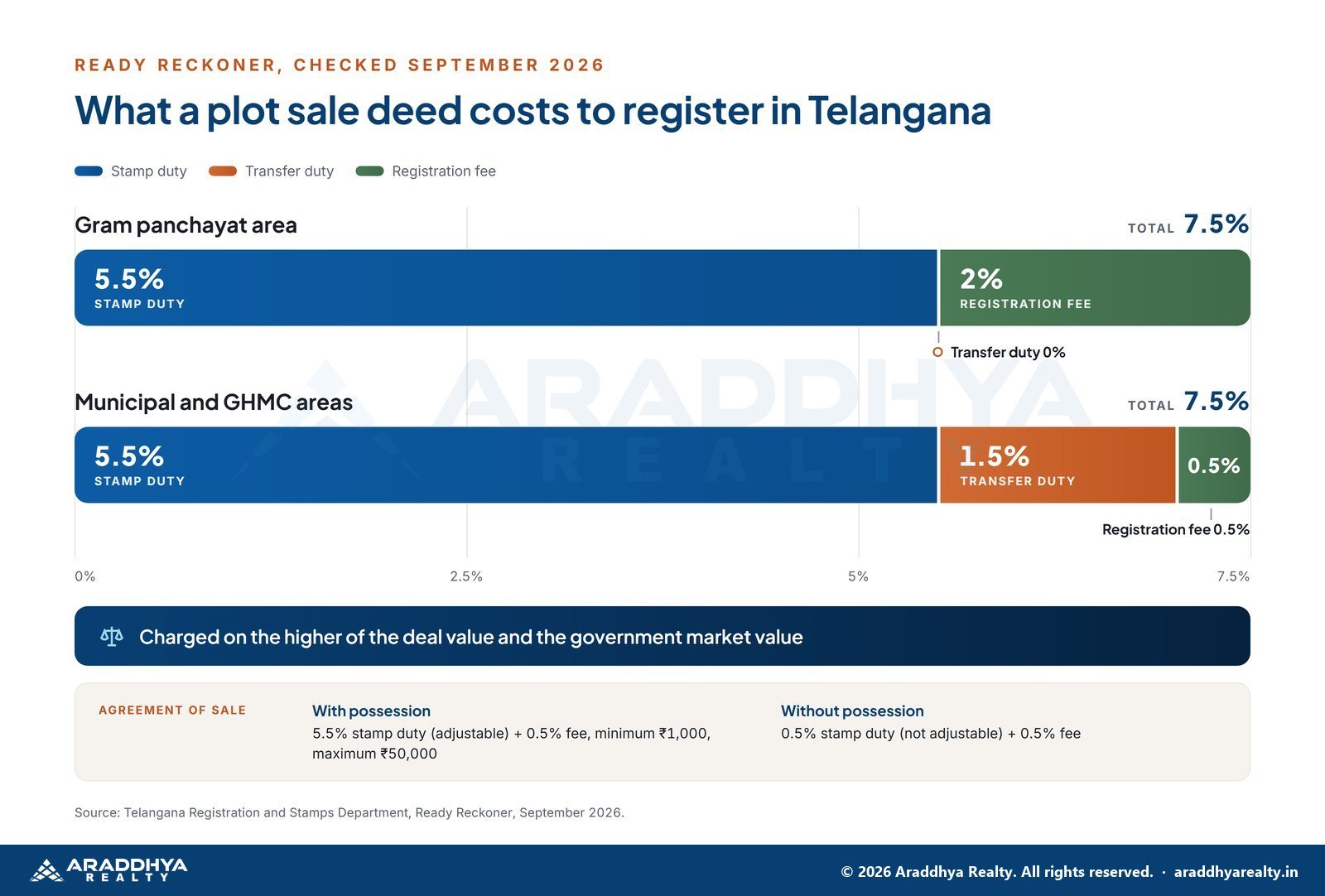
| Document | Stamp duty | Transfer duty | Registration fee | Total |
|---|---|---|---|---|
| Sale deed, gram panchayat area | 5.5% | 0% | 2% | 7.5% |
| Sale deed, other areas (municipal and GHMC) | 5.5% | 1.5% | 0.5% | 7.5% |
| Agreement of sale with possession | 5.5%, adjustable | 0% | 0.5% (min ₹1,000, max ₹50,000) | up to 6% |
| Agreement of sale without possession | 0.5%, not adjustable | 0% | 0.5% (min ₹1,000, max ₹50,000) | up to 1% |
Which row applies to you depends on the local body, not the mandal. Many villages in Kandukur and Maheshwaram mandals are still gram panchayats. By contrast, Tukkuguda and Shamshabad were among 27 urban local bodies the state Cabinet approved for merger with GHMC in November 2025. Either way, the total is 7.5%, so the row changes who receives the money rather than the size of your bill.
The two agreement rows matter if you sign before the sale deed. “Adjustable” means the stamp duty you paid on an agreement with possession is credited when you register the deed. On the other hand, the 0.5% on an agreement without possession is not credited, so it is an extra cost.
Market value versus deal value: which one sets the base
Every sale deed involves two numbers. The first is the deal value, the price you and the seller agree. The second is the market value, the government’s rate for that location, sometimes called the guidance value. The Ready Reckoner states that charges apply to the market value or the consideration, “whichever is higher”.
| Situation, 200 sq.yd plot (illustrative) | Deal value | Market value | Base for 7.5% | Charges |
|---|---|---|---|---|
| Deal value above market value | ₹40,00,000 | ₹12,00,000 | ₹40,00,000 | ₹3,00,000 |
| Market value above deal value | ₹40,00,000 | ₹44,00,000 | ₹44,00,000 | ₹3,30,000 |
In much of South Hyderabad, buyers pay well above the government value. In 2024, a department official told the Deccan Chronicle that customers had been paying “almost three times” the market value. So for most plots, your deal value sets the base. However, never write a lower price in the deed to save duty. It is unlawful, the sub-registrar can refer a suspected undervaluation for assessment, and it can create problems with your loan and a future resale. Our guide to South Hyderabad plot prices shows how listing prices, registered values and government values differ.
The June 2026 market value revision
The state revised market values across Telangana from 5 June 2026. Sakshi Post reported on 5 June 2026 that values rose in four tiers of 25%, 50%, 75% and 100%: most areas fell in the 25% to 75% tiers, and the 100% tier applied only to a few high-value locations in and around Hyderabad. The stamp duty and fee rates stayed the same. Buyers who had booked slots before 5 June were asked to pay the difference at the new values.
For context, the previous statewide revision took effect in February 2022. A revision planned for 1 August 2024 was deferred, according to the Deccan Chronicle (31 July 2024), and we found no statewide revision in 2025. To see the current value for your plot, use the Market Value Search on the Telangana Registration and Stamps Department portal. Select the district, the sub-registrar office and the village, then the locality or survey number.
How registration works: the portal, slot booking and the office visit
Registration of an open plot in an approved layout happens at the sub-registrar office (SRO) for that area. Agricultural land follows a different route through the Bhu Bharati portal at the tahsildar’s office. The process for a plot runs like this:
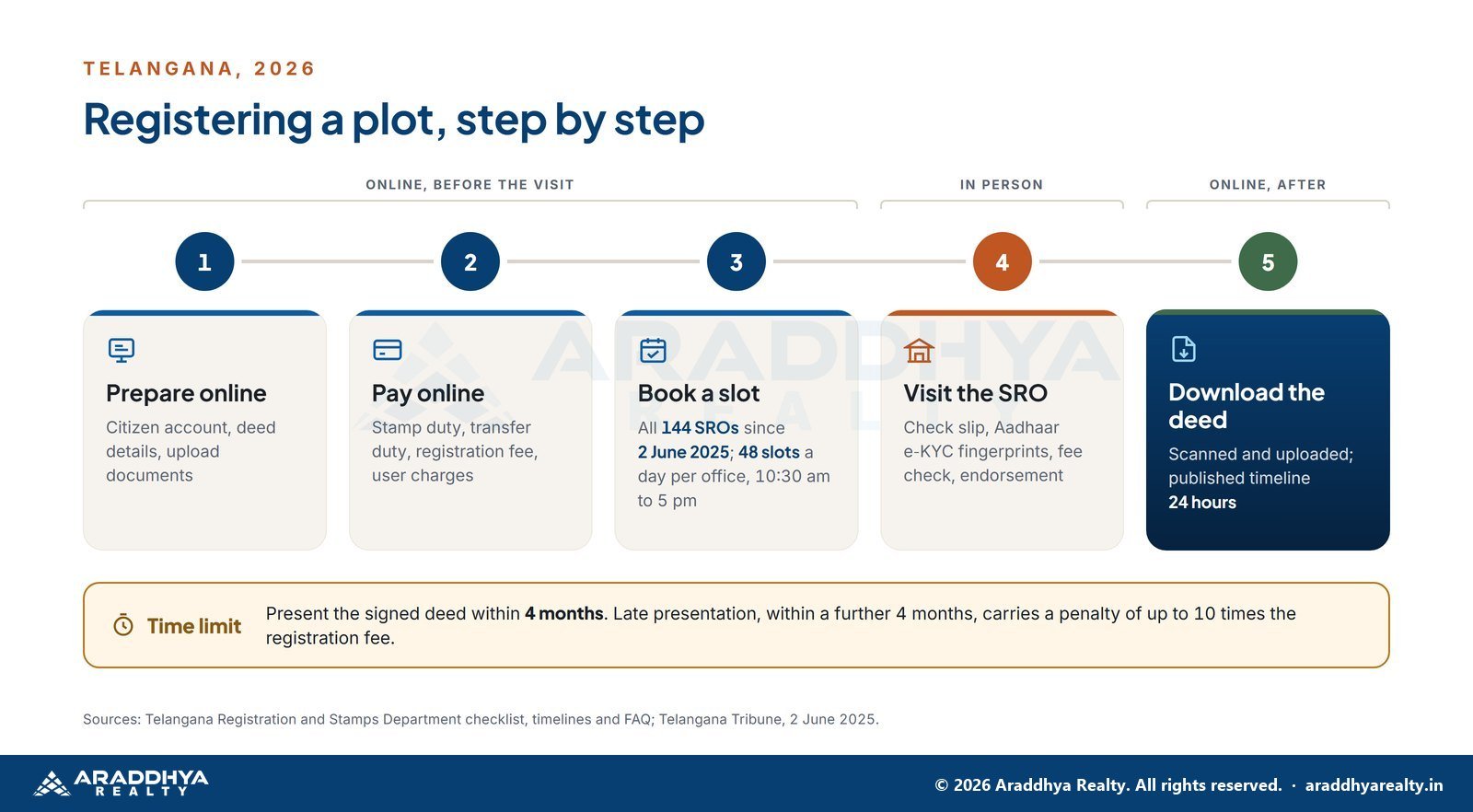
- Prepare the document online. Create a citizen account on the registration portal, enter the deed details and upload the documents on the checklist.
- Pay online. Pay the stamp duty, transfer duty, registration fee and user charges through the portal.
- Book a slot. Slot booking has covered all 144 SROs since 2 June 2025. Telangana Tribune reported 48 slots a day per office between 10:30 am and 5 pm, plus five walk-in registrations from 5 pm to 5:30 pm.
- Attend the SRO. The officer prepares a check slip, both parties complete Aadhaar e-KYC with fingerprints, the fees are verified and the document is endorsed and numbered.
- Download the deed. The registered document is scanned and uploaded. The department’s published timeline for registration and scanning is 24 hours.
Timing matters too. The department’s FAQ says a document may be presented within four months of signing. After that, it may be presented within another four months, but with a penalty of up to ten times the registration fee.
Documents to carry
The department’s checklist for presenting a sale deed includes:
- The original document signed by all parties, and proof of the online payment
- Photographs and the Section 32A photo form for the parties and witnesses, where required
- Two witnesses with photo identity
- Identity and address proof, such as Aadhaar, passport, driving licence, PAN or voter ID
- A photograph showing the front view of the property
- Copies of the link documents, meaning the earlier deeds in the chain
- Local body property documents, and any GPA or SPA, originals and copies
Before you book, also run an encumbrance search and the prohibited property check on the same portal; our encumbrance certificate guide shows how to read the result. Our list of clear title documents explains what each earlier deed should show.
Mutation: putting your name on local records
Registration records the transfer. Mutation then updates the local body’s property records, so that tax notices and future permissions come to you.
- Municipal and GHMC areas. Mutation is done at registration. The Hans India reported on 29 October 2020 that the fee is 0.1% of the registration value, with a minimum of ₹1,000 in municipalities and ₹3,000 in municipal corporations. Ask the SRO for the mutation certificate with your deed.
- Gram panchayat villages. Apply to the panchayat with a copy of the registered deed to transfer the property tax assessment into your name. The process and any fee are set locally, so ask the panchayat secretary.
The other costs to budget for
Stamp duty and fees are the largest items, but they are not the only ones. Here is what else can apply.
| Cost | Who sets it | What to expect, September 2026 |
|---|---|---|
| User charges and payment charges | Registration department | Set by the fee notification in force since 2 September 2021: ₹500 per document of up to 15 sheets, ₹1,000 above that, and ₹100 for a market value certificate. The portal shows the total at payment. |
| Encumbrance certificate | Registration department | Viewable through the portal’s EC search; a certified copy from an SRO or MeeSeva carries a small fee |
| Advocate’s title search and deed drafting | Market | Varies with the work; ask for a written quote |
| LRS charges | Planning authority | Only for an eligible plot in an unapproved layout; nil in an approved layout |
| Development charges | The layout seller | Some layouts bill roads, water or power per sq.yd; ask whether they are in the price and in the deed value |
| TDS at 1% | Income tax law | Applies when the price is ₹50 lakh or more; the buyer deducts and deposits it |
LRS deserves a special word. If a layout needs regularisation, it did not have approval when the plots were sold. Our explainer on HMDA vs DTCP approval covers how to check which authority approved a layout, and where FCDA now fits.
A worked example: a 200 sq.yd plot
This example is illustrative only. The price, the market value and the professional fees are assumptions for the arithmetic, not quotes for any location or layout. We assume an agreed price of ₹20,000 per sq.yd (₹40,00,000), a market value of ₹6,000 per sq.yd (₹12,00,000) and an approved layout.
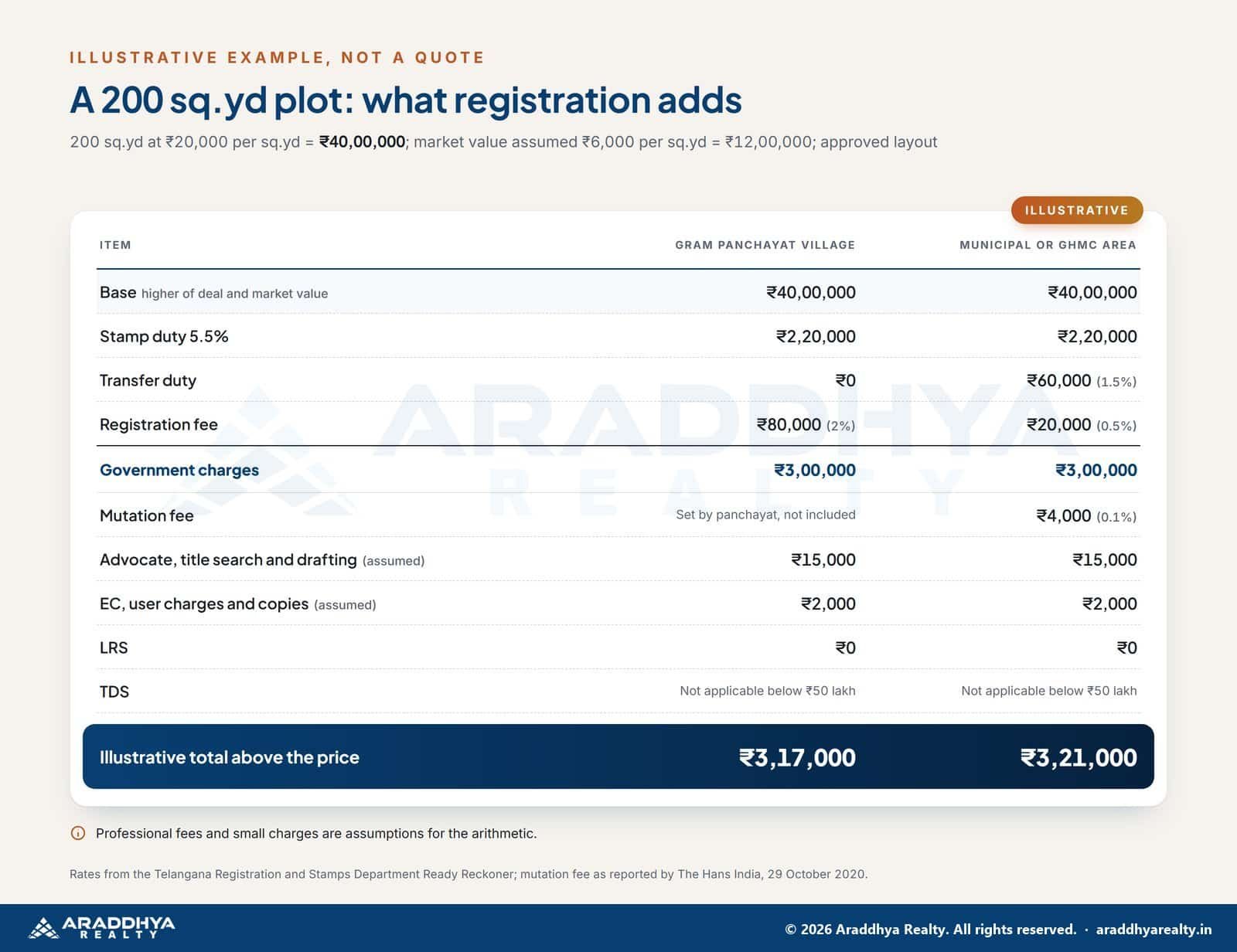
| Item | Gram panchayat village | Municipal or GHMC area |
|---|---|---|
| Base: higher of deal and market value | ₹40,00,000 | ₹40,00,000 |
| Stamp duty at 5.5% | ₹2,20,000 | ₹2,20,000 |
| Transfer duty | ₹0 | ₹60,000 (1.5%) |
| Registration fee | ₹80,000 (2%) | ₹20,000 (0.5%) |
| Government charges | ₹3,00,000 | ₹3,00,000 |
| Mutation fee | Set by the panchayat, not included | ₹4,000 (0.1%) |
| Advocate, title search and drafting (assumed) | ₹15,000 | ₹15,000 |
| EC, user charges and copies (assumed) | ₹2,000 | ₹2,000 |
| LRS | ₹0, approved layout | ₹0, approved layout |
| TDS | Not applicable below ₹50 lakh | Not applicable below ₹50 lakh |
| Illustrative total above the price | ₹3,17,000 | ₹3,21,000 |
In other words, set aside roughly 8% above the plot price in this example. If the market value for your village were higher than your deal value, the government charges would rise with it, as the second table above shows. Budgeting for a plot we show? Book a site visit and we will share its survey number so you can check the market value first.
Mistakes that cost buyers money
- Budgeting on the market value alone. If your deal value is higher, that is the base.
- Signing an agreement without possession first. Its 0.5% stamp duty is not credited against the sale deed.
- Missing the four-month window. Late presentation carries a penalty of up to ten times the registration fee.
- Treating registration as a title check. Registration records your purchase; it does not repair a weak chain of title. Run the plot verification checklist first.
This guide is general information, not legal advice. Rates, market values and procedures change, so confirm the figures for your document on the department’s portal, and have an advocate review the deed before you sign.
Plan your next step
Working out what you will pay to register a plot? Araddhya Realty is a TG-RERA registered agent (A02500007890). If a figure, a document or a village’s local body is unclear, Ask Araddhya Realty a question and we will help you read it. Prefer WhatsApp? Message us on WhatsApp.
Frequently asked questions
A sale deed costs 7.5% in total: 5.5% stamp duty plus either a 2% registration fee in gram panchayat areas, or 1.5% transfer duty and a 0.5% registration fee in other areas, per the department’s Ready Reckoner in September 2026.
On whichever is higher. The Ready Reckoner applies the charges to the market value or the consideration, whichever is higher, so a deal value above the government rate becomes the base.
The rates did not change. However, market values rose from 5 June 2026, in tiers of 25% to 100% as reported, so the base, and therefore the rupee amount, rose for many plots.
In municipal and GHMC areas, mutation happens at registration for 0.1% of the registration value, with a minimum of ₹1,000 in municipalities and ₹3,000 in corporations. In gram panchayats, apply to the panchayat.
Four months from signing, per the department’s FAQ. A further four months is allowed with a penalty of up to ten times the registration fee.
Yes. Slot booking has been available at all 144 sub-registrar offices since 2 June 2025, through the Registration and Stamps Department portal.
On a plot registered at ₹40 lakh, where that deal value is above the government market value, the 7.5% comes to ₹3,00,000. In a gram panchayat village that is ₹2,20,000 stamp duty plus a ₹80,000 registration fee; in a municipal or GHMC area it is ₹2,20,000 stamp duty, ₹60,000 transfer duty and a ₹20,000 registration fee, per the Ready Reckoner checked in September 2026.
Sources. Telangana Registration and Stamps Department: Ready Reckoner of stamp duty, transfer duty and registration fees; property registration checklist and timelines; registration FAQ; Market Value Search, all checked September 2026 · The Hans India: revised market values take effect, 6 June 2026; mutation charges in urban local bodies, 29 October 2020 · Sakshi Post: market value revision tiers, 5 June 2026 · Telangana Tribune: revised values from 5 June 2026, June 2026; slot booking in all sub-registrar offices, 2 June 2025 · Deccan Chronicle: market value revision deferred, 31 July 2024 · Telangana Today: market value revision, February 2022 · The News Minute: Cabinet approves merger of 27 urban local bodies with GHMC, November 2025.
This article is general information, not investment or legal advice. Figures are dated and change often. Verify approvals and project registration yourself at rera.telangana.gov.in and with the issuing planning authority before any purchase.
Useful next reads. LRS and BRS rules in 2026; how LRS status affects a plot; the ten checks before you pay; how the southern corridors compare; which approval applies where; how to test a brochure claim; areas we cover; buyer questions answered; all our guides.
Disclaimer · Privacy policy · Terms of use · Araddhya Realty home