
LRS Telangana 2026: What It Is, Who Needs It, Fees and How to Check Your Status
If you have looked at plots around Hyderabad, you have probably heard a seller say “LRS is applied” or “LRS is done”. Those two phrases mean very different things. This guide explains LRS Telangana in plain terms: what the scheme is, which plots need it, what the rebate windows of 2025 and 2026 offered, how the fee is worked out and how to check an application’s status. It closes with the questions to ask a seller before you pay anything.
LRS Telangana in short
Short answer: LRS Telangana, the Layout Regularisation Scheme notified under G.O.Ms.No.131 of 31 August 2020, regularises plots in unapproved layouts whose sale deed was registered on or before 26 August 2020. A 25% rebate on LRS charges for 2020 applicants ran from 1 May to 31 July 2026 and was reported extended to 30 November 2026.
Key takeaways
- ✓The Layout Regularisation Scheme (LRS) regularises plots in unapproved layouts. It was notified under G.O.Ms.No.131 of 31 August 2020.
- ✓It applies to plots whose sale deed was registered on or before 26 August 2020. About 25.44 lakh applications were filed in 2020, according to the state government.
- ✓A 25% rebate on LRS charges ran from 1 May to 31 July 2026 and was then extended to 30 November 2026, as reported by the Deccan Chronicle. It is for 2020 applicants who have not cleared their dues.
- ✓“LRS applied” is not an approval. A plot is regularised only when proceedings are issued.
- Check status on lrs.telangana.gov.in with the 2020 application number and registered mobile number; 2020 applications in HMDA limits are tracked there too.
What LRS is, and why it exists
A layout is supposed to get permission from the planning authority before any plot is sold. That permission fixes road widths, open spaces and drainage. For years, however, many layouts around Telangana’s towns were sold without it. The owners of those plots could not get building permission or, often, a bank loan.
The Layout Regularisation Scheme is the state’s route for bringing such plots into the formal planning system. Once a plot is regularised, the owner can apply for building permission like any other. The state government’s own press note of February 2024 says that successful applicants become eligible for construction permits, bank loans and property transactions.
LRS is not the same as a layout approval. It is a one-time correction for plots that were sold without one. So if a seller mentions LRS at all, the layout did not have approval when the plots were sold. Buying in a layout that already holds planning permission avoids LRS; book a site visit and ask us for the permission copy first.
Which plots need LRS, and which cannot get it
In broad terms, a plot needs LRS if it sits in a layout that never received permission from HMDA, DTCP, a municipality or, now, FCDA. The 2020 scheme set clear limits:
- The cut-off date. Only plots with a sale deed registered on or before 26 August 2020 are eligible. A plot first sold in an unapproved layout after that date cannot be regularised under this scheme.
- The 10% rule. Since February 2025, the state has allowed the remaining plots in an unapproved layout to be regularised if at least 10% of its plots were sold by registered deed before the cut-off, as reported by the Deccan Chronicle.
- Excluded lands. Government, endowment and waqf lands, and plots under court cases, are outside the scheme, according to the February 2024 press note. Officials were also told to keep strict limits on prohibited lands, including flood-prone areas.
The 2020 applications
The scheme accepted applications between 31 August and 31 October 2020. The fee was ₹1,000 for an individual plot and ₹10,000 for a layout. The state government’s figures from February 2024 show how the applications were split:
| Where the plot is | Applications (2020) |
|---|---|
| Municipal corporations | about 4.13 lakh |
| Municipalities | about 10.54 lakh |
| Gram panchayats | about 10.76 lakh |
| Total | about 25.44 lakh |
Processing then stalled for several years. The Hans India reported in 2026 that the state had collected about ₹1,000 crore against a projection of ₹20,000 crore, which shows how many applicants had not yet paid.
The rebate windows of 2025 and 2026
To move the pending applications, the government offered a 25% rebate on LRS charges more than once. Here is the sequence, with what we could confirm.
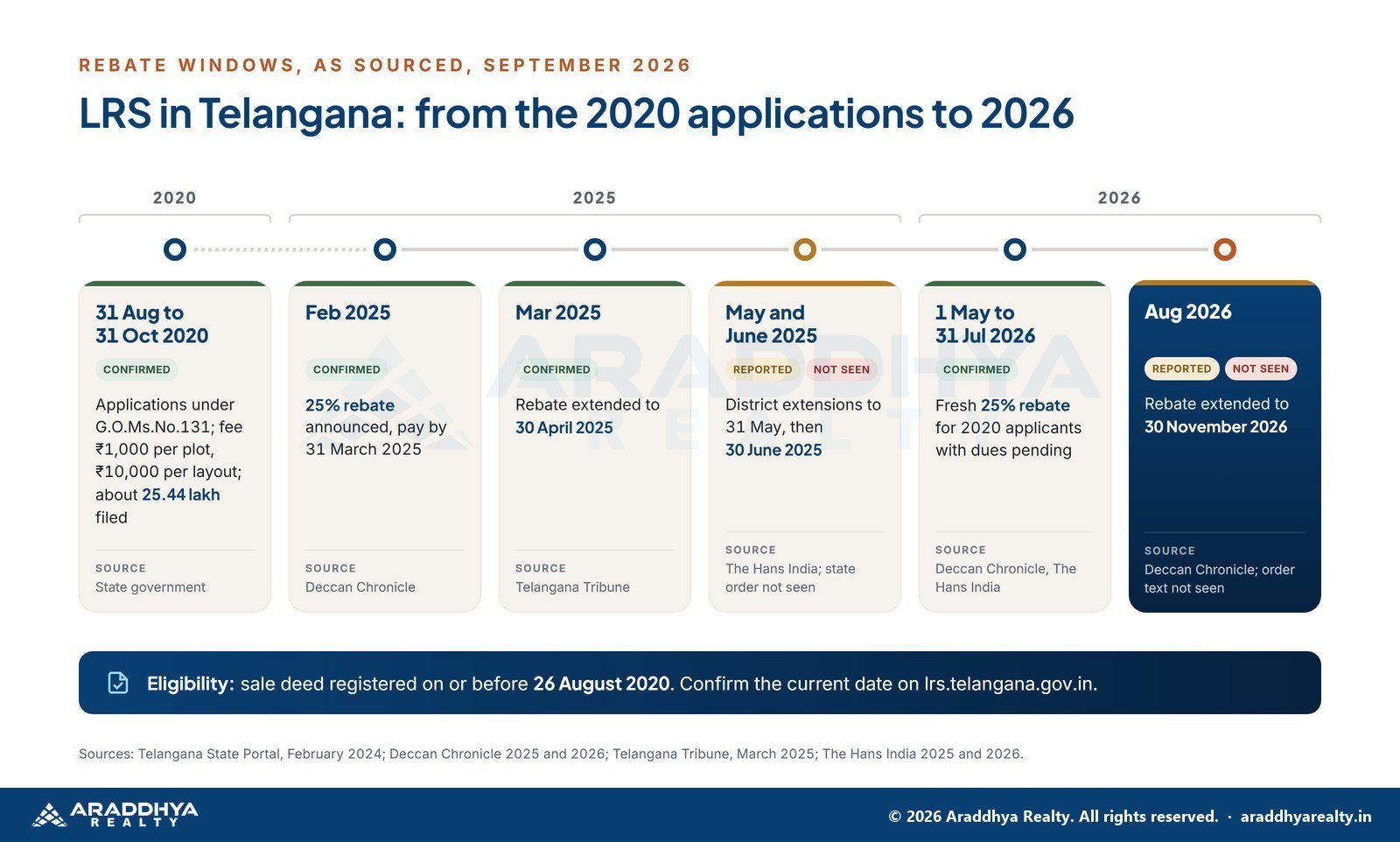
| Date | What happened | Status |
|---|---|---|
| 31 Aug to 31 Oct 2020 | Applications accepted under G.O.Ms.No.131 | Confirmed, state government |
| February 2025 | 25% rebate announced, pay by 31 March 2025 | Confirmed, Deccan Chronicle |
| March 2025 | Rebate extended to 30 April 2025 | Confirmed, Telangana Tribune |
| May and June 2025 | District collectors announced extensions to 31 May, then 30 June 2025 | Reported by The Hans India; state order not seen |
| 1 May to 31 July 2026 | A fresh 25% rebate for 2020 applicants with dues pending | Confirmed, Deccan Chronicle and The Hans India |
| August 2026 | Rebate extended to 30 November 2026 | Reported by Deccan Chronicle; G.O. text not seen |
In 2025, the rebate covered regularisation charges and pro-rata open space charges. However, applicants who chose to defer open space charges to the building permission stage lost the rebate. In 2026, the state announced a 25% rebate on LRS fees and charges for 2020 applicants who had not paid in full (Telangana Tribune and The Hans India, 30 April 2026); the fee intimation on the portal shows which charges apply to your file. Because we have not seen the order for the latest extension, confirm the current date on the LRS portal before you rely on it.
How LRS fees are calculated
The LRS fee is not a flat amount. It has two main parts.
- Regularisation charges. These start from a basic rate per square metre that rises with plot size. A percentage is then applied, based on the government market value of the plot on 26 August 2020. The slabs below come from the September 2020 revision reported by the Deccan Chronicle.
- Pro-rata open space charges. If the layout does not leave 10% of its area as open space, the owner pays 14% of the plot value, taken on the date the plot was registered.
The 2020 revision also folded the fee for converting agricultural land to non-agricultural use into the regularisation charges, so there is no separate conversion fee.
| Market value on 26 Aug 2020, per sq.yd | Share of basic charge payable |
|---|---|
| Up to ₹3,000 | 20% |
| ₹3,001 to ₹5,000 | 30% |
| ₹5,001 to ₹10,000 | 40% |
| ₹10,001 to ₹20,000 | 50% |
| ₹20,001 to ₹30,000 | 60% |
| ₹30,001 to ₹50,000 | 80% |
| Above ₹50,000 | 100% |
Two cautions apply. Firstly, calculators online quote basic rates of ₹200 to ₹750 per square metre, but we could not confirm those figures from the order itself. Secondly, fee intimations have gone wrong: Telangana Today reported a 200-yard plot at Jadcherla billed ₹27.33 crore, later corrected to ₹30,034. So treat the fee intimation on the portal as the figure that counts, and question anything that looks wrong.
How to check LRS status online
LRS status check in brief: open lrs.telangana.gov.in, choose Application Search or Citizen Login, and enter the application number from your 2020 receipt with the registered mobile number. The page shows the current stage, from documents requested to proceedings issued. 2020 applications in the HMDA area are tracked on the same portal; HMDA’s own LRS and BRS site holds the orders of the older 2015 scheme. For every screen, stage and the proceedings download, see our LRS application status guide.
Most applications from municipalities and gram panchayats sit on the state LRS portal. HMDA’s separate LRS and BRS portal holds the orders of the 2015 scheme; 2020 applications in HMDA limits are tracked on the state portal as well. The steps below are for the state portal:
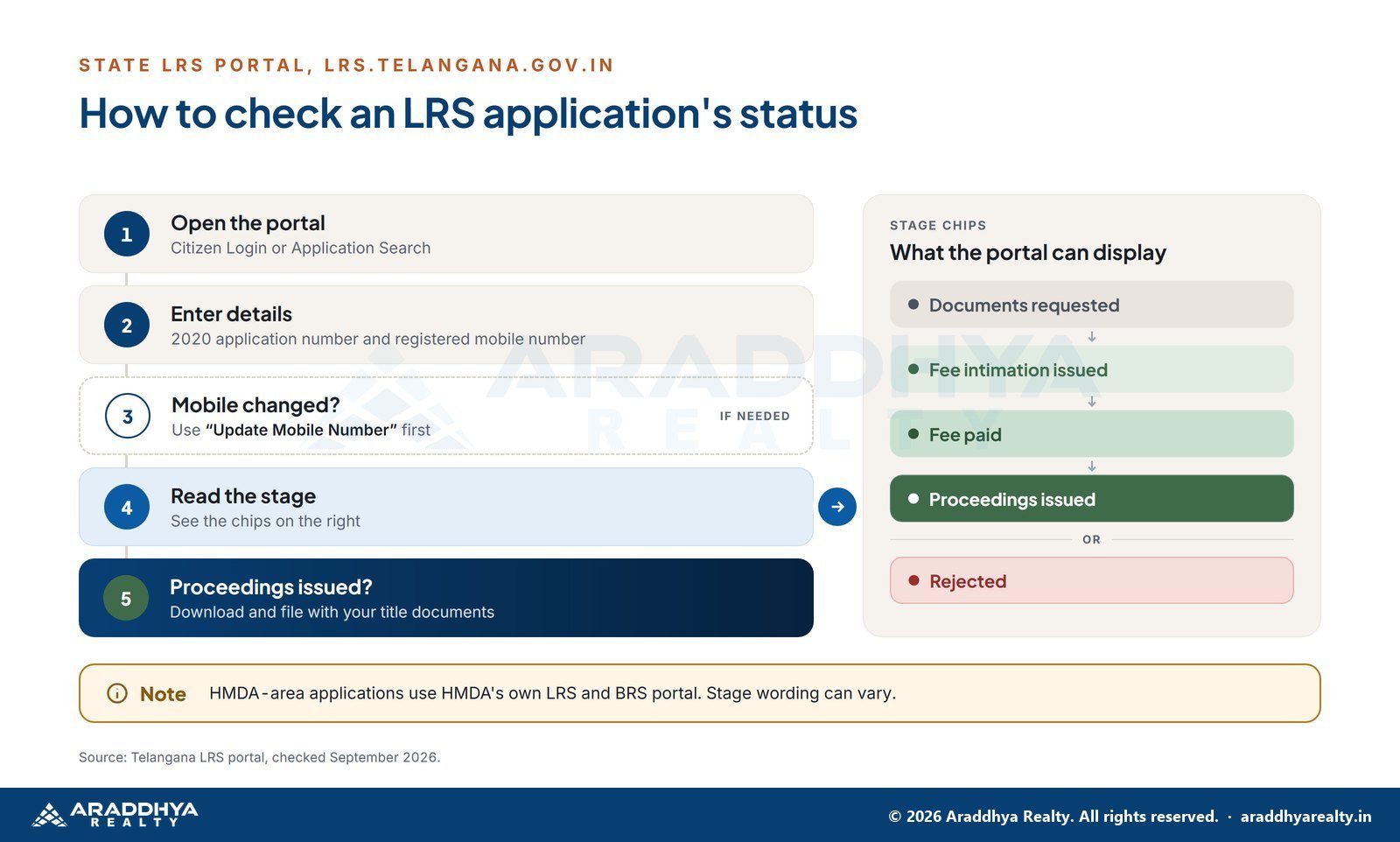
- Open the portal and choose Citizen Login or Application Search.
- Enter the application number from the 2020 receipt, and the mobile number registered with it.
- If the mobile number has changed, use the Update Mobile Number link first.
- Read the current stage: documents requested, fee intimation issued, fee paid, proceedings issued, or rejected. The exact wording can vary.
- If proceedings are issued, download them and keep a copy with your title documents.
The status is only as good as the application number. As a buyer, ask the seller to show you the live status on their phone, not a screenshot.
What each LRS status means
The portal wording can vary, but an application moves through these stages. Read the stage before you rely on anything a seller says about LRS.
| Status shown | What it means | What to do |
|---|---|---|
| Documents requested | The authority needs more papers | Upload them, or ask the seller when they will |
| Fee intimation issued | Charges have been worked out and are due | Check the figure; fee intimations have gone wrong before, so question anything that looks off |
| Fee paid | Money received; the plot is not yet regularised | Wait for proceedings; ask whether open space charges were deferred |
| Proceedings issued | The plot is regularised | Download the proceedings and keep them with your title documents |
| Rejected | Regularisation refused | Ask why; government, endowment and waqf land and plots under court cases are outside the scheme |
The 25% rebate for 2020 applicants was reported extended to 30 November 2026, so confirm the date on the portal before you pay.
What an LRS-pending plot means for a buyer
Buying a plot with LRS still pending is a different proposition from buying in an approved layout. Here is what it means in practice:
- No building permission yet. Until the proceedings are issued, you cannot get a building permission for the plot.
- Loans are harder. Banks usually want an approved layout or regularisation proceedings before they lend.
- Charges can pass to you. If the fee is unpaid, someone has to pay it. Unless your agreement says otherwise, that may be you.
- Outcomes are not certain. An application can be rejected, for example if the land falls in an excluded category.
If you would rather buy where LRS does not arise, look at layouts that already hold a layout permission. Our Kandukur and Pulimamidi pages name the permission for each layout we show; ask us for a copy before you book a site visit.
For how LRS fits among the other approvals, our plot verification checklist places it in the full sequence of checks.
HMDA, DTCP and FCDA: who handles your application
Which body handles LRS depends on where the plot is, and in South Hyderabad that changed in 2025.
| Area | Who handles LRS | What to check |
|---|---|---|
| HMDA area | HMDA, with 2020 files on the state LRS portal | Application number on lrs.telangana.gov.in (HMDA’s own portal covers the 2015 scheme) |
| Municipalities and gram panchayats outside HMDA | The local body, with DTCP scrutiny, through the state portal | Status on lrs.telangana.gov.in |
| The 56 FCDA villages (G.O.Ms.No.69, 12 March 2025) | Not clearly published for 2020 applications | Ask both FCDA and the original authority in writing |
G.O.Ms.No.69 moved 36 villages from HMDA and 20 from DTCP into the Future City Development Authority. We could not find a published order on who now processes the 2020 LRS applications for those villages, so confirm it before you rely on any status. Our explainer on HMDA vs DTCP approval covers the three authorities in more detail.
Questions to ask a seller about LRS
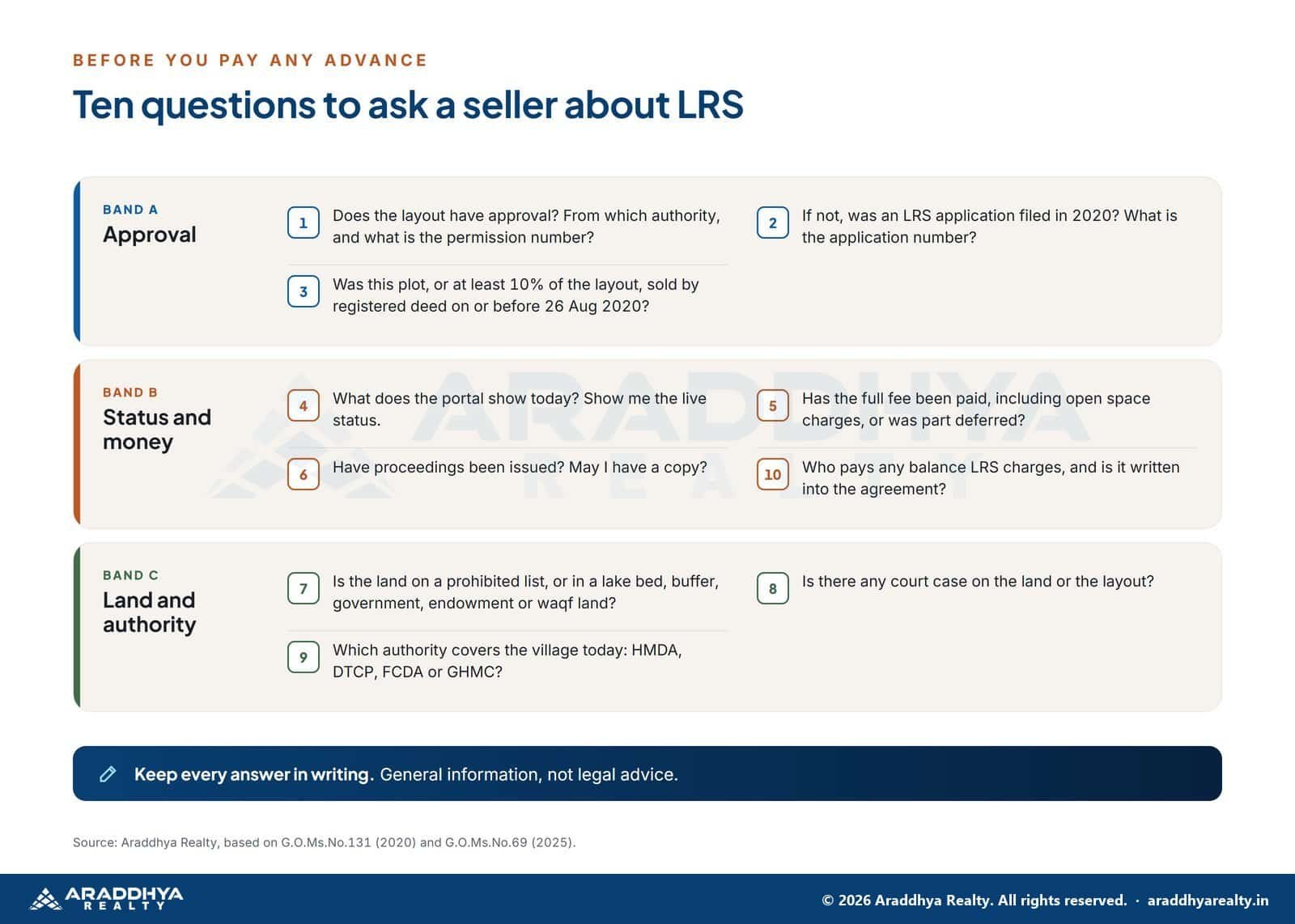
- Does the layout have approval, and from which authority? What is the permission number?
- If not, was an LRS application filed in 2020? What is the application number?
- Was this plot, or at least 10% of the layout, sold by registered deed on or before 26 August 2020?
- What does the portal show today? Please show me the live status.
- Has the full fee been paid, including open space charges, or was any part deferred?
- Have proceedings been issued? May I have a copy?
- Is the land on any prohibited list, or in a lake bed, buffer, government, endowment or waqf land?
- Is there any court case on the land or the layout?
- Which authority covers the village today: HMDA, DTCP, FCDA or GHMC?
- Who will pay any balance LRS charges, and will that be written into the agreement?
Keep the answers in writing, and match them against the documents. Our guide to clear title documents covers the ownership papers that should sit alongside any LRS proceedings.
This guide is general information, not legal advice. LRS rules, deadlines and fee rules change by government order, so confirm the current position on the LRS portal and with the authority for your village, and ask an advocate to review the papers.
Plan your next step
Weighing a plot where LRS comes up? Araddhya Realty is a TG-RERA registered agent (A02500007890). If a status, a fee intimation or an authority is unclear, Ask Araddhya Realty a question and we will help you work through it. Prefer WhatsApp? Message us on WhatsApp.
Frequently asked questions
The Layout Regularisation Scheme regularises plots in layouts that were sold without planning approval. It was notified under G.O.Ms.No.131 of 31 August 2020, and a regularised plot can then get building permission.
Owners of plots in unapproved layouts whose sale deed was registered on or before 26 August 2020. Since February 2025, the remaining plots in a layout also qualify if at least 10% were sold before that date, as reported.
The 2026 rebate ran from 1 May to 31 July 2026, and the Deccan Chronicle reported an extension to 30 November 2026. We have not seen the order text, so confirm the date on the LRS portal.
On lrs.telangana.gov.in, use Citizen Login or Application Search with your 2020 application number and registered mobile number. Applications in the HMDA area use HMDA’s own LRS portal.
No. An application only shows that the owner asked for regularisation. The plot is regularised when proceedings are issued, so ask for the proceedings copy.
You can, but you cannot get building permission until proceedings are issued, loans are harder and unpaid charges may pass to you. Settle who pays in the agreement.
The Telangana LRS portal shows where an application stands. Documents requested means the authority needs more papers. Fee intimation issued means charges are worked out and due. Fee paid means the money is in, but the plot is not yet regularised. Proceedings issued means it is regularised, so download the copy. Rejected means regularisation was refused. Exact wording can vary.
We found no published order on who processes 2020 LRS applications for the 56 villages that moved to the Future City Development Authority under G.O.Ms.No.69 of 12 March 2025. Check the portal of the original authority, HMDA or the state LRS portal, and ask both FCDA and that authority in writing before relying on any status.
Sources. G.O.Ms.No.131, MA&UD, 31 August 2020, Layout Regularisation Scheme · Telangana State Portal, press release “Expedite LRS Scheme-2020”, February 2024 · Deccan Chronicle: LRS rates revised, 18 September 2020; 25% rebate till 31 March, February 2025; rebate ends 31 July, 28 July 2026; rebate extended to 30 November, August 2026 · Telangana Tribune: rebate extended to 30 April 2025, March 2025 · The Hans India: district extensions to 31 May and 30 June 2025; 25% rebate from 1 May to 31 July 2026, 2026 · The News Minute: LRS charges reduced, 18 September 2020 · Telangana Today: abnormal LRS fee intimations, 2025 · G.O.Ms.No.69, MA&UD, 12 March 2025 · LRS portal, lrs.telangana.gov.in, checked September 2026.
This article is general information, not investment or legal advice. Figures are dated and change often. Verify approvals and project registration yourself at rera.telangana.gov.in and with the issuing planning authority before any purchase.
Useful next reads. what registration costs in 2026; the ten checks before you pay; how the southern corridors compare; which approval applies where; how to test a brochure claim; areas we cover; buyer questions answered; all our guides.
Disclaimer · Privacy policy · Terms of use · Araddhya Realty home