
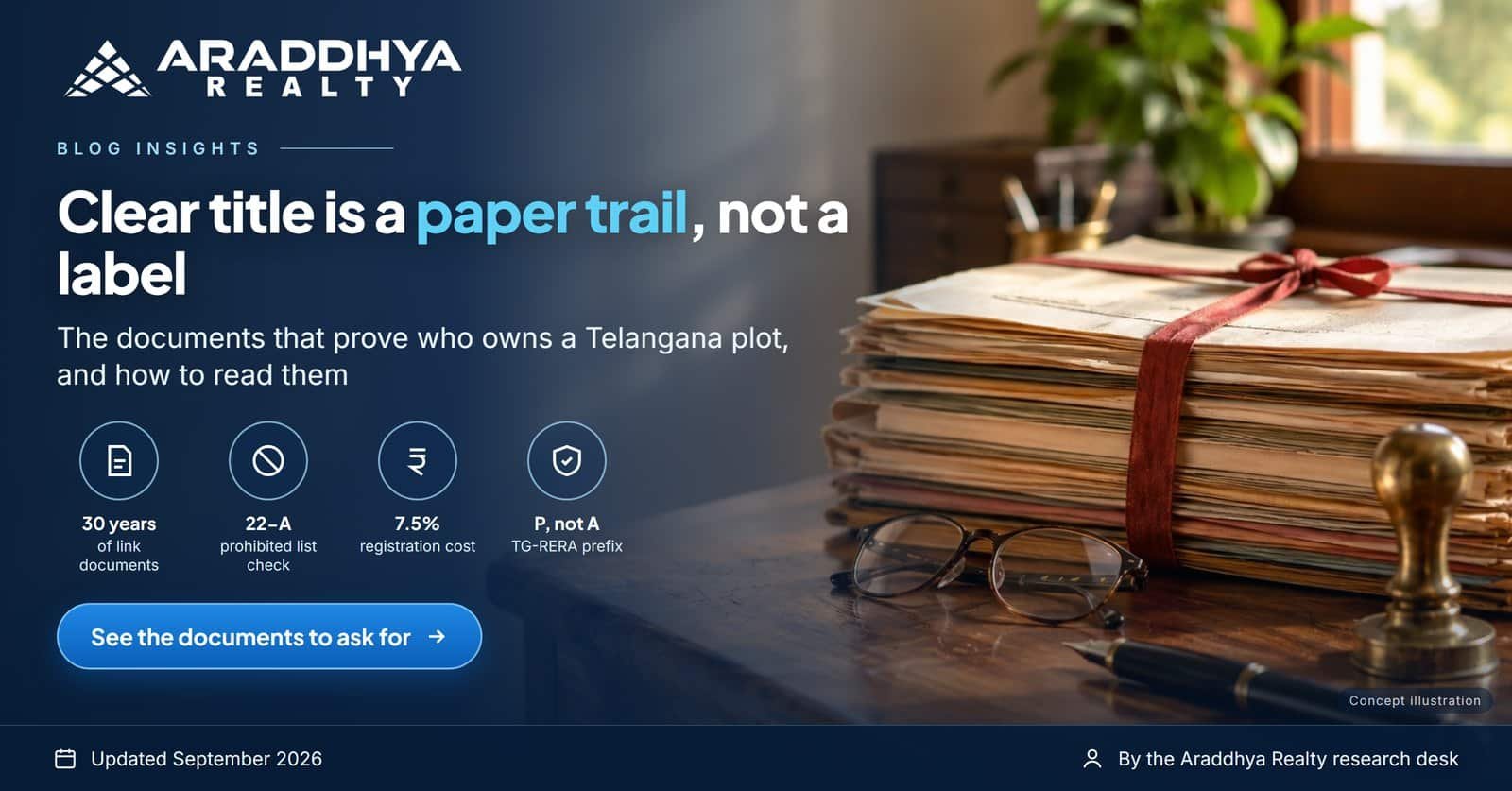
Clear Title Documents: What to Check Before You Buy a Plot in Telangana
Almost every layout brochure in Hyderabad prints the words “clear title”, so the term needs defining. A clear title means the seller has undisputed legal ownership. In addition, the land carries no mortgage, pending litigation, government restriction or acquisition order on record. However, the brochure proves none of that; the clear title documents do. This guide therefore explains which to ask for, what each shows, and what it cannot.
Short answer: Clear title documents for a Telangana plot are the mother deed and link documents covering at least 30 years, the encumbrance certificate, the revenue record, a 22-A prohibited property check, land classification and any Change of Land Use order, the layout permission and plan, the TG-RERA registration and any development agreement. Your own advocate should read them before any advance.
Key takeaways
- ✓A clear title rests on a chain of registered deeds, not a label. So ask for the mother deed and every link document, covering at least 30 years.
- ✓The encumbrance certificate (EC) shows only the transactions registered against the land for the period you ask for. However, unregistered claims and older years do not appear.
- ✓Check the survey number against Telangana’s 22-A prohibited property register. Also confirm the land classification and any Change of Land Use order.
- ✓The layout permission (LP) number and TG-RERA registration should match the title papers on land and promoter. So verify both yourself, at source.
What "clear title" actually means
Title is the legal right to own and transfer land. It is “clear” only when four things are true at the same time.
- The seller, or a promoter acting for the owners, can legally sell this exact survey number and plot.
- Each earlier transfer in the chain has a valid, registered deed.
- No mortgage, charge, court case or government restriction sits on the land.
- You can lawfully use the land as a residential plot, and approvals exist to show it.
Most disputes grow in the gaps between those four. For example, a developer may lack the right to sell one plot. Similarly, an old family claim on one survey number may still be open. Moreover, no single document covers all four.
The clear title documents to ask for
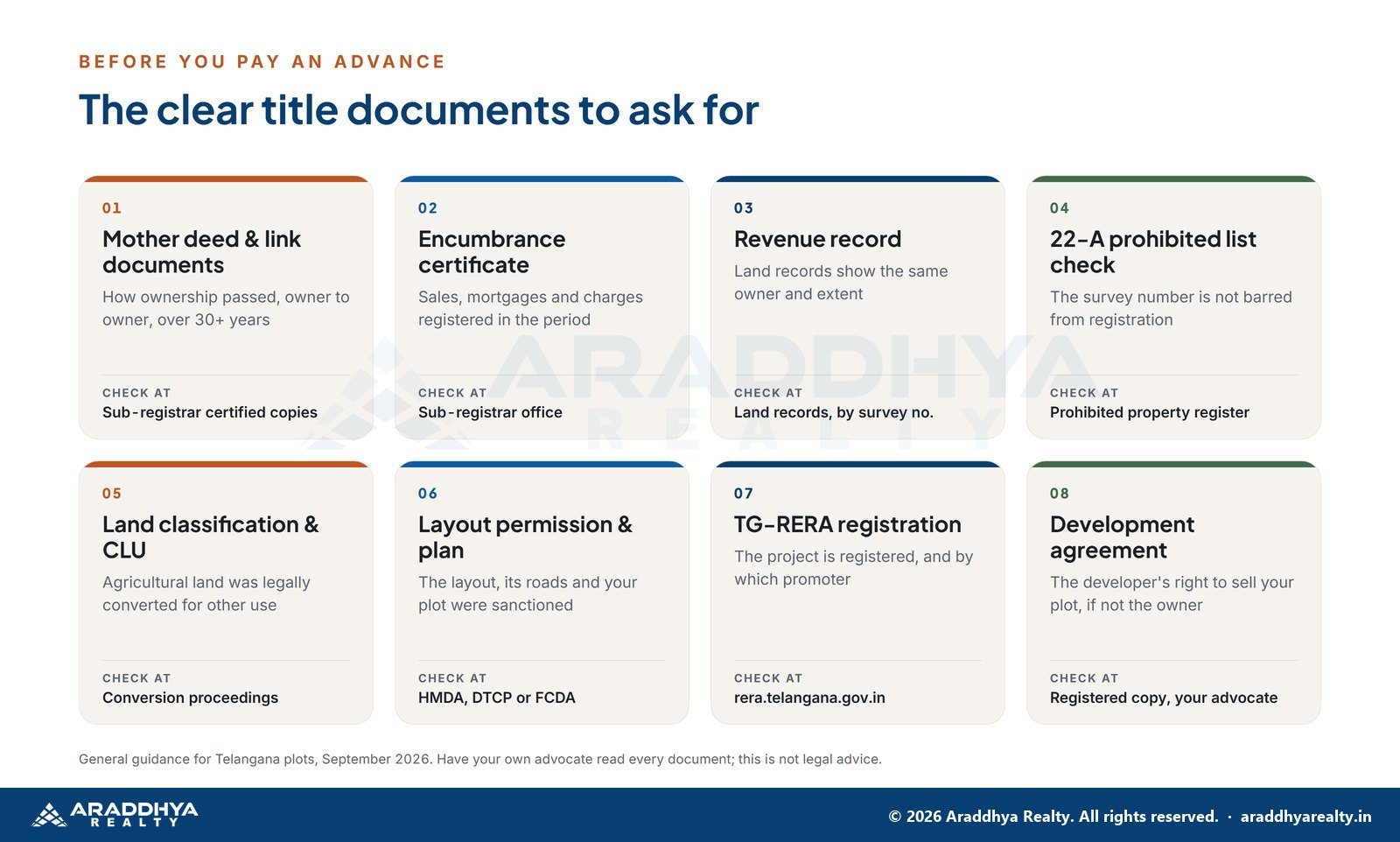
| Document | What it proves | Where to check it |
|---|---|---|
| Mother deed and link documents | How ownership passed, owner to owner, over 30+ years | Sub-registrar certified copies, read by your advocate |
| Encumbrance certificate (EC) | Sales, mortgages and charges registered in the period requested | Sub-registrar office or the state registration portal |
| Revenue record for the survey number | That the land records show the same owner and extent as the deeds | Land records, by village and survey number |
| 22-A prohibited property check | That the survey number is not barred from registration | Prohibited property register, by survey number |
| Land classification and CLU order | That agricultural land was legally converted for non-agricultural use | Conversion proceedings from the revenue department |
| Layout permission and approved plan | That the layout, its road widths and your plot number were sanctioned | The issuing authority: HMDA, DTCP or FCDA |
| TG-RERA registration | That the plotted project is registered, and by which promoter | rera.telangana.gov.in |
| Development agreement, if any | The developer’s right to sell your plot on the landowners’ behalf | Registered copy, checked by your advocate |
How a 30-year title search works
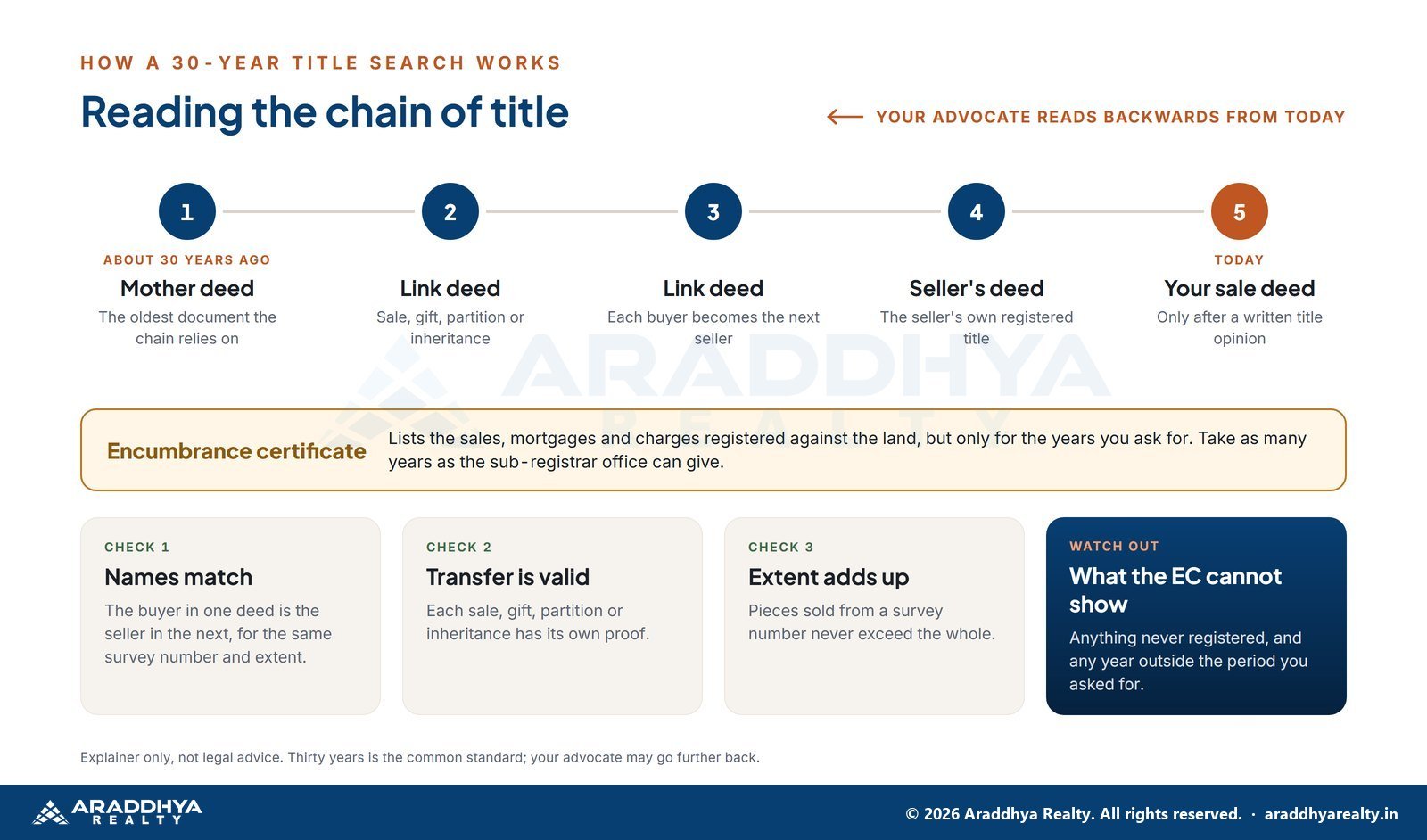
Your own advocate should run the title search, not the seller’s. The search starts with the seller’s sale deed and works backwards, deed by deed. It stops when the chain reaches a document old enough to rely on. Generally, thirty years is the common standard.
At each link in the chain, the advocate checks three things.
- The names match. The buyer in one deed must be the seller in the next, for the same survey number and extent.
- The transfer was valid. A sale, gift, partition or inheritance each needs its own proof. Inheritance needs extra care, because an heir left out of a family settlement can raise a claim years later.
- The extent adds up. If someone split a survey number, the pieces sold cannot exceed the whole.
Finally, the report should end with a written opinion on whether the title is marketable. It should also list what needs fixing before registration.
Reading an encumbrance certificate properly
Buyers ask for the EC more than any other clear title document, and they misread it most often. It lists the sales, mortgages and other charges registered against a property for the period you ask for.
However, it does not show two things.
- Unregistered transactions, such as an unregistered agreement of sale or an informal family arrangement.
- Anything outside the period you asked for. For example, an EC for 13 years says nothing about year 14.
So take an EC for as many years as the sub-registrar office can provide. Then match every entry to a deed in the chain, and ask whether any bank charge sits on the land.
Clear title and an approved layout are separate questions. For instance, a plot in an HMDA-approved layout can still carry a title defect in one survey number. Equally, a spotless title does not make an unapproved layout legal. So you need both. Our guide to HMDA vs DTCP approvals covers the approval side.
Checks beyond the deeds
Some clear title documents come from outside the chain of deeds, so check these three as well.
The 22-A prohibited property register
Telangana keeps a register of prohibited properties, usually called the 22-A list, of survey numbers barred from registration. A clean chain of deeds does not help if your survey number is on it. Search by exact village and survey number before you pay any advance.
Land classification and conversion
You cannot use agricultural land for residential construction without a Change of Land Use order. So ask for the conversion proceedings, not a verbal assurance. Be especially careful with “farm plots”. Telangana bars registration of farm plots below 2,000 sq m, roughly 2,392 sq.yd. It also requires an approved layout copy where a farm plot abuts a new road.
Who is actually selling
On rera.telangana.gov.in, a number starting with P is a project or promoter registration. In contrast, one starting with A is an agent registration. The promoter on the project’s registration should match the owners in your title documents. Otherwise, the promoter should hold a registered development agreement with them. If the brochure’s name differs, ask why, in writing.
Why clear title documents matter after you buy
A clean title makes a plot registrable, financeable and resaleable. For instance, a lender is unlikely to finance a disputed title. Later, your future buyer’s advocate will run the same search you run now.
Also, registration does not repair a weak chain; it records your purchase on top of it. Stamp duty and registration in Telangana cost about 7.5% of the higher of the agreement or government market value. The state revised those values statewide on 5 June 2026. Our guide to South Hyderabad plot prices also shows how to check a price against registered values.
Title work is one reason buying a plot differs from buying a flat. Our comparison of open plots vs apartments covers the rest.
A simple order of work
- Get the survey number, village and plot number in writing.
- Check the TG-RERA registration and LP number at source. Search the project on rera.telangana.gov.in, then confirm the LP with the authority that issued it.
- Collect the mother deed, link documents and EC, and hand them to your own advocate for a title search report.
- Run the 22-A check and confirm the land classification, including any CLU order.
- Walk the plot with the approved layout plan and match the plot number, pegs and road width.
- Finally, pay a token advance only after the advocate’s written opinion.
Our full plot verification checklist adds the approval, LRS and site checks.
Plan your next step
Want the paperwork before you visit? Ask us for the layout permission, TG-RERA number, survey number and title documents for any plot we show. Then have your own advocate read them before you pay anything. Request the documents. Prefer WhatsApp? Message us on WhatsApp.
Frequently asked questions
The mother deed and link documents, the encumbrance certificate, the revenue record, a 22-A check, land classification and any CLU order, the layout permission and plan, the TG-RERA registration, and any development agreement.
At least 30 years is the common standard. However, your advocate may go further back if the chain includes inheritance or partition.
No. An EC shows only registered transactions for the period you request, so read it alongside the full chain of link documents.
No, because layout approval and title are separate. An approved layout can still contain a survey number with a title defect, so check both.
On rera.telangana.gov.in. Then check that the number starts with P, that the promoter name matches your documents, and that the project type says plotted development or layout.
Sources. Telangana Real Estate Regulatory Authority (TG-RERA) registration search · Telangana Registration and Stamps Department, market value revision effective 5 June 2026 · Telangana directions on farm plot registration below 2,000 sq m · Araddhya Realty plot verification checklist.
This article is general information, not investment or legal advice. Figures are dated and change often. Verify approvals and project registration yourself at rera.telangana.gov.in and with the issuing planning authority before any purchase.
Useful next reads. what registration costs in 2026; how LRS status affects a plot; the ten checks before you pay; how the southern corridors compare; which approval applies where; how to test a brochure claim; areas we cover; buyer questions answered; all our guides.
Disclaimer · Privacy policy · Terms of use · Araddhya Realty home