
Plot Verification Checklist: 10 Checks Before You Pay Anything for an Open Plot in Telangana (2026)
Most plot-buying problems in Telangana trace back to a check nobody ran before the first payment. So this plot verification checklist puts the ten checks that matter in the order that protects your money. Desk checks come before any token advance, and legal checks before the agreement. Finally, a site and paperwork check comes before registration. A genuine seller should share every document on this list without you having to chase.
Short answer: A plot verification checklist for Telangana has ten checks in three stages: layout permission, TG-RERA registration and seller authority before any advance; title, encumbrance certificate, 22-A list, land use and LRS status before the agreement; then a site walk and registered agreement before registration. Under the RERA Act, promoters should not take more than 10% before a registered agreement for sale.
Key takeaways
- ✓Three stages, ten checks: desk checks before any advance, then legal checks with your own advocate before the agreement. Finally, a site walk and paperwork check before registration.
- ✓Check the authority, not just the number. Since 12 March 2025, 56 Future City villages have come under the FCDA instead of HMDA or DTCP. The FCDA has accepted applications since December 2025, with no layout approvals reported as of 5 November 2026.
- ✓TG-RERA registers projects; it does not approve them. So search the project and promoter name yourself at rera.telangana.gov.in.
- ✓“LRS applied” and “LRS approved” differ. In fact, 2026 reporting showed 33,096 approvals among 290,369 HMDA LRS applications, about 11%.
- ✓Under the RERA Act, promoters should not take more than 10% of the price before a registered agreement for sale.
The plot verification checklist at a glance
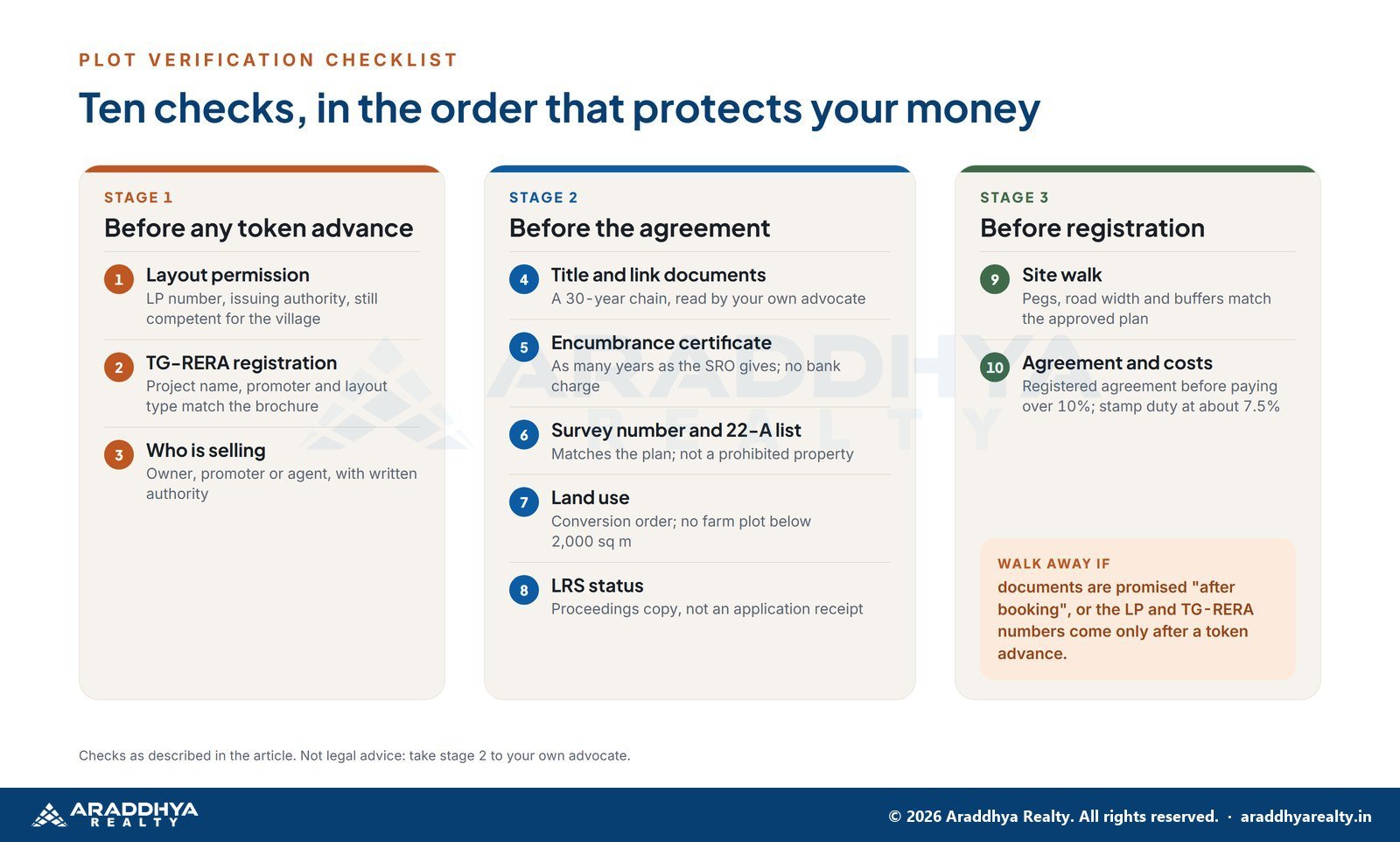
| Stage | Check | What you are confirming |
|---|---|---|
| Before any advance | 1. Layout permission | LP number, issuing authority, still competent for the village |
| 2. TG-RERA registration | Project name, promoter and layout type match | |
| 3. Who is selling | Owner, promoter or agent, with written authority | |
| Before the agreement | 4. Title and link documents | An unbroken chain of ownership, read by your own advocate |
| 5. Encumbrance certificate | No registered mortgage or charge on the land | |
| 6. Survey number and 22-A list | The land is not a prohibited property | |
| 7. Land use | Converted for non-agricultural use, outside restricted zones | |
| 8. LRS status | Regularisation approved, not just applied for | |
| Before registration | 9. Site walk | Pegs, roads and buffers match the approved plan |
| 10. Agreement and costs | Registered agreement, correct stamp duty, receipts |
Work through the plot verification checklist in order, because each stage protects the money you pay next.
Stage 1: plot verification before any token advance
1. Layout permission and the issuing authority
Ask for the layout permission (LP) number and the proceedings copy, then check which authority issued it. HMDA approves layouts inside the metropolitan region, whereas DTCP approves those outside it. That is also the short answer to how to verify HMDA approval. Start from the LP number and proceedings copy, then confirm them with HMDA itself.
However, since G.O.Ms.No.69 of 12 March 2025, a third authority applies in the south: the Future City Development Authority (FCDA). It covers 56 revenue villages across about 765 sq km, including villages in Kandukur and Maheswaram mandals. The FCDA has accepted layout and building applications through the BuildNow platform since December 2025, with no layout approvals reported as of 5 November 2026. Our explainer on HMDA vs DTCP approval covers the differences in detail.
2. RERA plot verification: TG-RERA project registration
RERA plot verification takes a few minutes. Search the project on rera.telangana.gov.in, not on a screenshot. Then check three things: the promoter’s name, the exact registered project name, and the project type. The type should be a layout or plotted development. If the brochure’s name or promoter differs from the registration, ask why, in writing.
Two points of language matter. First, TG-RERA registers projects; it does not approve them. So be wary of any brochure that uses the word “approved” for a RERA registration. Second, agents hold their own, separate registrations, so an agent’s registration number is not a project registration.
3. Who is actually selling
The person across the table may be the landowner, the promoter or a marketing agent. All three can be legitimate. However, if the seller is not the landowner, ask for the development agreement or written marketing mandate. That document should give them the right to sell your specific plot number.
Stage 2: plot document verification before the agreement
Then take these to your own advocate, not one the seller suggests. Our guide to clear title lists each document in detail.
4. Plot title and link documents
The link documents show how the land passed from owner to owner. So ask for a title search covering at least 30 years, and make sure no transfer in the chain is missing.
5. The encumbrance certificate for plot buyers
An encumbrance certificate (EC) for a plot lists the sales, mortgages and charges registered against that land. However, it covers only the period you request. It also leaves out unregistered transactions and anything outside that period. So take one covering as many years as the sub-registrar office can provide, and at least 30. Then ask directly whether any bank charge sits on the land.
6. Survey number and the 22-A list
Match the survey number on the sale documents with the approved layout plan and the village map. Then check whether it appears on Telangana’s 22-A prohibited properties list of land barred from registration. It needs a village-and-survey-number search, so ask your advocate to run it and show you the result.
7. Land use and conversion
You cannot build houses on agricultural land without a Change of Land Use order. So ask for the land classification and the conversion order. Be especially careful with “farm plots”: Telangana bars registration of farm plots below 2,000 sq m (about 2,392 sq.yd). Around the Osman Sagar and Himayat Sagar catchments, GO 111 conservation restrictions also apply.
8. LRS status
The Layout Regularisation Scheme (LRS) is the route to regularise an unapproved layout. In other words, if a layout needs LRS, it had no approval at the time of sale. Only plots with a sale deed registered before 26 August 2020 are eligible.
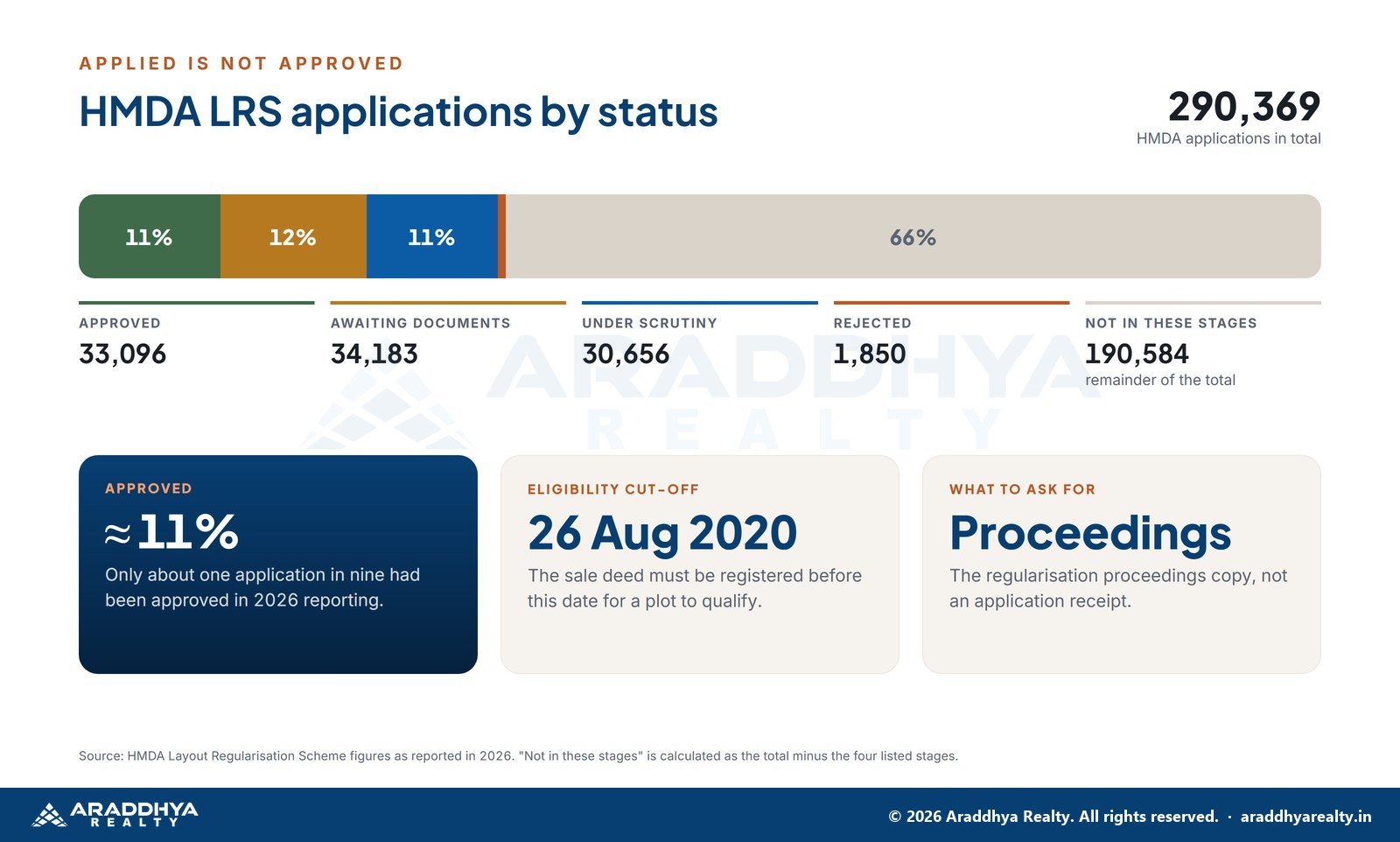
Sellers often use “LRS applied” and “LRS approved” as if they meant the same thing. However, of 290,369 HMDA applications, 33,096 had received approval, about 11%. The rest stood rejected, awaiting documents, under scrutiny or not yet processed. So ask for the LRS approval status in writing, and for the regularisation proceedings, not an application receipt.
Inside the Future City area, re-verify older approvals. After the 12 March 2025 transfer, HMDA and DTCP were no longer the planning authority for the 56 FCDA villages. So confirm any permission issued before that date with the authority that issued it. Also ask whether the FCDA requires anything further. Our Bharat Future City guide explains which areas the change affects.
Stage 3: final plot verification before registration
The last two items on the plot verification checklist take you to the site and then to the sub-registrar office.
9. Walk the plot with the approved plan
Take the approved layout plan to the site. Check that the boundary pegs match your plot number and dimensions, and that the internal road width matches the plan. Also confirm that the approved plan includes the layout’s access road. In addition, look out for these physical red flags:
- Nala and lake buffers, where rules restrict building.
- High-tension power lines over or beside the plot.
- Road widening lines near a highway frontage.
10. The agreement, the money and the stamp duty
Under the RERA Act, a promoter should not accept more than 10% of the price before a registered agreement for sale. Also get a receipt for every payment. At registration, stamp duty and registration cost about 7.5% of the higher of your agreed price and the government value. Because the state revised government values statewide on 5 June 2026, check the value for your survey number before you budget.
Where to check each item on the plot verification checklist
| Document | Who issues it | How to check it | Red flag |
|---|---|---|---|
| Layout permission | HMDA, DTCP or FCDA | With the issuing authority | The authority no longer covers the village |
| TG-RERA registration | TG-RERA | rera.telangana.gov.in | A different project name or promoter |
| Encumbrance certificate | Sub-registrar office | Apply for the period you need | A short period, or a bank charge |
| Land classification and conversion | Revenue records | Through your advocate | A “farm plot” below 2,000 sq m |
| LRS proceedings | The authority that regularised the layout | Ask for the proceedings copy | Only an application receipt |
Red flags that mean stop
If you see any of these, stop before you pay.
- The seller asks for a token advance before sharing the LP number or the TG-RERA registration.
- The brochure describes approvals vaguely, without naming the permission and the authority, or uses “approved” for a RERA registration.
- The project name, promoter or plot count on the registration differs from the brochure.
- The price leans on a future metro line or the southern Regional Ring Road. However, the airport to Future City metro is proposed as of September 2026, with no published alignment. It awaits central approval, and so does the southern RRR.
- The seller says the documents will come “after booking”.
Plan your next step
Want help reading the documents? Bring the LP number, TG-RERA number and survey number of any plot you are considering. We will then go through the plot verification checklist with you and show where to check each one. Still deciding between land and a flat? If so, read our open plots vs apartments guide, or talk to our team. Prefer WhatsApp? Message us on WhatsApp.
Frequently asked questions
Search the project at rera.telangana.gov.in, then match its registered name, promoter and project type to the brochure.
At least 30, or as many as the sub-registrar office can provide, because an EC shows only registered transactions.
Confirm it with the issuing authority, because 56 Future City villages have fallen under the FCDA since 12 March 2025.
An application only requests regularisation, whereas approval comes with regularisation proceedings.
Under the RERA Act, no more than 10% of the price before a registered agreement for sale.
Telangana bars registration of farm plots below 2,000 sq m, about 2,392 sq.yd, so check the size before you pay.
Sources. TGRERA FAQ · Real Estate (Regulation and Development) Act, 2016, sections 3, 12 and 13 · G.O.Ms.No.69, MA&UD Department, 12 March 2025 · HMDA Layout Regularisation Scheme application figures, 2026 · Telangana Registration and Stamps Department, market value revision effective 5 June 2026 · Directive to the IG of Stamps and Registration on farm-plot registration · Hindustan Times and Swarajya, Metro Phase II approval status, 2026.
This article is general information, not investment or legal advice. Figures are dated and change often. Verify approvals and project registration yourself at rera.telangana.gov.in and with the issuing planning authority before any purchase.
Useful next reads. what registration costs in 2026; how LRS status affects a plot; how the southern corridors compare; which approval applies where; how to test a brochure claim; areas we cover; buyer questions answered; all our guides.
Disclaimer · Privacy policy · Terms of use · Araddhya Realty home